Executive Summary
Background
A key aspect of the evolution of modern warfare is the development of kill process constructs, such as kill chains, kill webs, or kill meshes. First articulated by U.S. Air Force General John Jumper, a kill process refers to the steps a military must take from locating a target to delivering an effect. Since the term was first articulated, militaries around the globe have engaged in efforts to reduce the time it takes to move “from sensor to effector” (or more colloquially, “from sensor to shooter”) and to increase the flexibility and resilience of these processes.
Analysts from the People’s Republic of China (PRC), many affiliated with China’s military and national security apparatus, have closely observed the development of kill process constructs in the U.S. and assessed what this development might mean for China’s military. These analysts also incorporate these constructs into discussion of Chinese military issues, such as People’s Liberation Army (PLA) assessments of its operations, equipment, systems, and capabilities.
The threat from PRC kill processes to U.S. forces is described in the 2025 Department of War (DoW) China Military Power report and has been highlighted by leaders of the U.S. Space Force. Despite the threat PRC kill processes pose to U.S. forces, PRC-produced research on kill processes is underexamined by US-based scholars.
The purpose of this report is to examine research produced by analysts affiliated with China’s military and national security apparatus discussing kill processes. The report will describe key themes, identify the main research lines of effort (LOEs), and explore what this research suggests about how far along the PRC and PLA are in conceptualizing, developing, and deploying kill processes in military operations.
Key terms
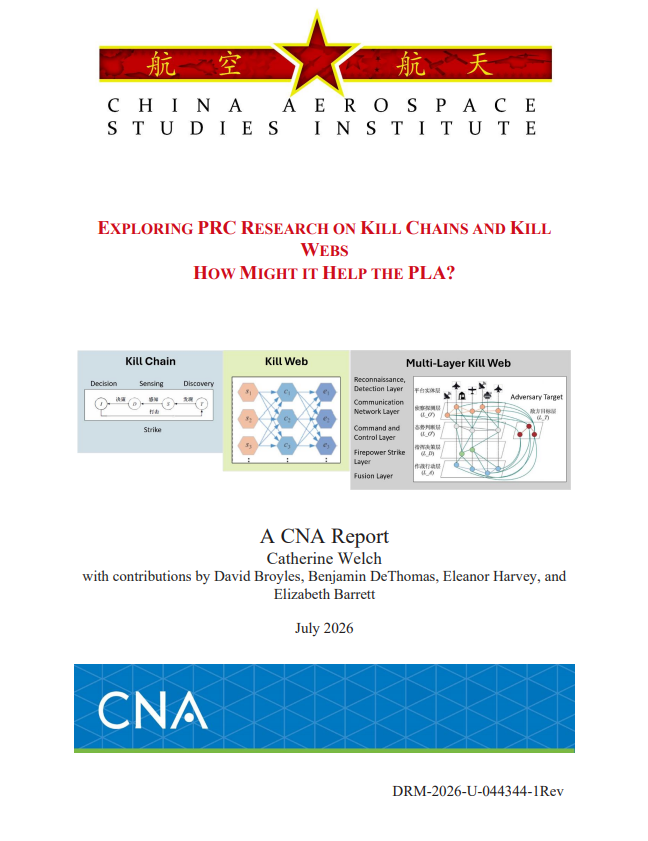
Kill chain: A sequence of steps that connects specific nodes (e.g., sensors, networks, weapon systems) to achieve a desired kinetic or nonkinetic effect on a target.
Kill web: A collection of multiple sequences of steps and nodes that provides multiple pathways to accomplish a desired kinetic or nonkinetic effect on a target.
Kill mesh: A collection of many potential pathways and diverse systems and nodes that requires algorithms to determine sequences to achieve outcomes. Kill meshes are more resilient than chains and webs, but their sequences may be less predictable.
Kill process: A CNA term used to refer collectively to kill chains, webs, and meshes.
Findings
Examining PRC research
Research on kill process constructs appears to be a priority in the PRC and PLA. Researchers affiliated with China’s military and national security apparatus are engaged in intense research efforts on kill processes. Over the course of our research, we identified a large and relatively recent dataset of PRC writing on kill processes and related concepts. Much of the research was undertaken by researchers associated with civilian government– or military-affiliated institutions. Moreover, almost half of the articles we identified indicated that the research received some level of civilian government or military funding.
PRC kill process–related research described in this dataset contains the following LOEs:
- Building kill processes. PRC researchers describe the fundamental building blocks and logic of kill processes, the types of kill sequences, and rules that must be followed. They also experiment with generating kill webs.
- Modeling the nodes and systems involved in kill processes. PRC analysts use mathematical modeling and network modeling techniques to improve the performance of kill webs.
- Evaluating the capability of kill processes. PRC researchers establish metrics to assess the validity, applicability, effectiveness, and performance of kill chains.
- Simulating how kill processes perform. PRC researchers use simulations to verify effectiveness, generate data, calibrate models, and test their research in scenarios.
- Developing technologies to enable kill processes. PRC researchers describe the development of some technologies that would enable connections between sensors, command units, weapons, and platforms to improve the PLA’s kill processes.
Adopting a U.S. concept for a PRC problem set
PRC writers depict kill processes as U.S. constructs and argue that kill processes will shape future warfare. These authors emphasize the importance of kill processes in modern operations. Their research shows intention to adopt these constructs and apply them to PRC problem sets.
PRC writers closely follow the evolution of U.S. military thinking underlying kill process concepts. They also closely follow discussion of U.S. operational concepts, such as the U.S. Navy’s Naval Integrated Fire Control-Counter Air, the Defense Advanced Research Projects Agency’s Mosaic Warfare, and DoW’s Joint All-Domain Command and Control.
PRC writings on kill processes treat the U.S. as an implied pacing threat. PRC analysts use U.S. military constructs and technologies as a reference point. Often, when PRC analysts describe what the PRC needs to develop, the desired capabilities are described relative to U.S. capabilities and include an implied requirement that the PRC be able to close its kill chain faster than the U.S. can close its own.
PRC views of kill processes and modern warfare
Kill process research resonates with PRC researchers in part because it aligns with and complements PLA views on the changing character of warfare that emphasize increasing levels of complexity, integration, artificial intelligence (AI), and autonomy.
- The PLA envisions warfare evolving through three stages (mechanization, informatization, and intelligentization).
- PLA strategists describe a shift from confrontation that formerly was platform centric to one that is system centric and involves system-on-system confrontation.
- The PLA’s evolving doctrine emphasizes integrated joint operations, all-domain operations, and multidomain precision warfare while leveraging whole-of-nation resources.
Future kill webs are part of an intelligent, systems-focused approach to warfare. From PRC researchers’ perspective, in addition to improvements to individual sensors, platforms, and equipment, this approach to warfare requires the following technological improvements:
- The ability to enable diverse connections across sensors, platforms, humans, and systems
- The ability to fuse disparate and multisource data
- The ability to accommodate the scope and scale of data collection and transmission
- The ability to process and analyze data in a way that in a way that supports decision-making and command and control (C2)
- The ability to intelligently generate future kill webs systems that have desired characteristics in terms of accuracy, capability, resiliency, and speed
In this context, kill process–related research serves an important function for PRC and PLA analysts. The PLA is facing system-wide challenges in preparing for future war. By combining the logic of kill process research with new methodologies and technologies, PLA researchers can move beyond narrowly focusing on the performance of any particular platform or sensor in a single domain, and can think holistically and systemically about how different nodes function together across domains and—in theory—across civilian and military systems to improve the PLA’s ability to conduct intelligent warfare, joint operations, and system-on-system confrontation.
PRC researchers aspire to use enabling technologies such as AI, big data and cloud computing, communication, networking, commercial order management, and uncrewed platforms to develop future kill webs that are:
- Capable of aggregating capabilities
- Dynamic
- Accurate (precise)
- Effective (capable, reliant)
- Adaptable
- Rapid (fast, quick, efficient)
- Complex
- Resilient (self-healing)
- Cross-domain capable
- Redundant (robust)
- Distributed
- Self-organized
PRC researchers in this field identify challenges that China and the PLA must address and ways that they hope kill process research will mitigate these challenges. The following table summarizes these challenges and mitigation measures.
|
Challenge that justifies kill process research |
How kill process research will mitigate weaknesses and challenges |
|
Shortening kill process timelines |
|
|
Identifying key nodes |
|
|
Optimizing C2 |
|
|
Coordinating operations across platforms |
|
Progress toward adoption
When examining PRC kill process research, it is useful to think of the PRC adoption of kill processes as part of a three-phase process:
- Conceptualization. During this phase, analysts are thinking about the concept of kill processes and how to incorporate them.
- Developing. During this phase, the defense research and development (R&D) complex is engaged in developing concrete technologies and capabilities to enable kill processes.
- Deploying. During this phase, the military would deploy and use kill processes in military operations.
Using this construct as a lens to view our data, we make the following observations:
The bulk of our data captures PRC analysts’ efforts to conceptualize kill processes. This is not surprising for two reasons: (1) conceptualization efforts are captured most easily in academic journals and tend to be the type of content that these journals publish, and (2) conceptualization efforts represent thoughts under consideration rather than policy decisions. Thus, the content is less sensitive and therefore more likely to be publicly accessible.
Within the PRC defense R&D complex, some evidence exists of PRC pursuit, development, and patenting of technologies (e.g., hardware, software, cloud-based capabilities) needed to actualize these capabilities.
Currently, our dataset of PRC-published kill process–related research does not contain detailed discussion portraying that China’s military has operationalized kill webs. Other than a brief Ministry of National Defense statement about optimizing kill chains in recent PLA exercises, the closest reflections of operationalization we see in PRC-published research are discussions about simulations, which is also not surprising. However, more in-depth discussions of how kill processes are operationalized are likely highly sensitive and thus less likely to appear in PRC-produced publications.
Statements in the 2025 DoW China Military Power report and by leaders for the U.S. Space Force suggest that PRC publications do not fully represent China’s progress in operationalizing kill processes. PRC kill process research suggests that aspirations in the PRC defense R&D complex are much greater than are current PLA demonstrations of capabilities. PRC researchers are attempting to use the U.S. kill process construct to help the PLA assess its operations, equipment, systems, and capabilities; identify weaknesses and inefficiencies; and identify how to make improvements in a wide range of areas (e.g., acquisition of new technology, platforms, and sensors or changes in C2).
Conclusion
PRC and PLA research on kill processes has the potential to lead to changes in the short and long term:
- In the short term, how the PLA uses the results of kill process research may inform planning, processes, and decisions that allow the Chinese military to adjust its practices for procurement, deployment of forces, allocation of resources, and C2, for example.
- In the long term, PRC efforts to construct sensor and communication networks (e.g., for civilian emergency response in times of peace or national defense mobilization in conflict) and fuse civilian and military resources and capabilities in support of national security may serve as a foundation to realize kill process capabilities.
- However, PRC writings contain descriptions of challenges related to the development and operationalization of kill processes, and it is unclear how difficult these challenges will be to address.
For U.S. analysts, this may be a valuable time to monitor PRC and PLA writing about kill processes to see how the discussion evolves, to watch for the types of data that emerge about kill processes, and to prepare to identify improvements in PLA operations that result from the PLA adopting and innovating this construct.
Download reportApproved for Public Release.
Details
- Pages: 70
- Document Number: DRM-2026-U-044344-1Rev
- Publication Date: 7/20/2026