On March 23, the Japan Maritime Self-Defense Force (JMSDF) underwent major organizational reform that included the establishment of a new Fleet Information Warfare Command (FIWC). The new command elevates information warfare to the responsibility of a vice admiral—replacing a lower-level organization headed by a captain. The FIWC signals Japan’s prioritization of information warfare amid growing challenges in the information environment, cultivating a more decisive US ally for information warfare cooperation. Specifically, it provides the US Navy an additional resource for maintaining a rapid and persistent forward sensing posture in the Indo-Pacific.
First outlined in Japan’s 2022 Defense Buildup Program, the FIWC is seen as a countermeasure against countries using disinformation and strategic communications to shape public opinion and decision-making as a precursor to conflict. China exemplifies this threat, having launched over 200 cyberattacks against Japan within a five-year period to access its national security and advanced technology data. Using artificial intelligence, autonomous systems, and other technologies, China is pursuing cognitive advantages through “intelligentized warfare.” In response, Japan is attempting to strengthen its intelligence capabilities to address integrated information warfare by its 2027 fiscal year.
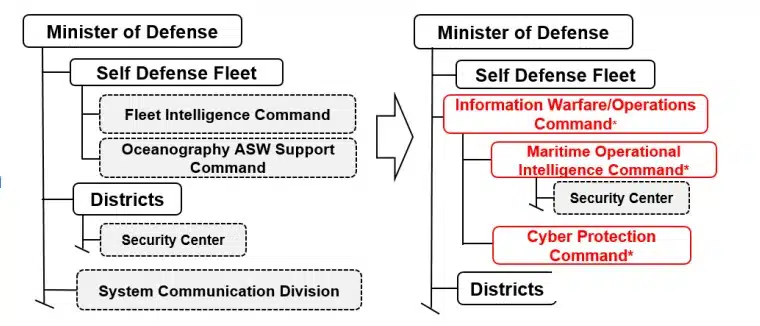
The FIWC consists of redistributed intelligence and cyber functions from the now defunct Fleet Intelligence Command, in addition to units specializing in oceanography and communications. Since 1997, the Fleet Intelligence Command served as the sole intelligence-focused unit under the direct command of the Self-Defense Fleet, the JMSDF’s maritime operations force. The new FIWC, in contrast, is commanded by the Defense Minister and of equal status to the Self-Defense Fleet. It centralizes various information-related capabilities including counter-disinformation, electronic warfare, cyberwarfare, and acoustic intelligence, as well as command, control, communications, computers, intelligence, surveillance and reconnaissance, or C4ISR.
Modeled after US Fleet Cyber Command/Tenth Fleet, the FIWC does not possess ships, aircraft, or submarines. Rather, it serves as the JMSDF’s operational hub for providing units with timely information on information warfare threats, such as attempted cyberattacks or deception activities, and protects at-sea communication networks to prevent the disruption of fleet operations. This chart from Japan’s Ministry of Defense illustrates the overall command change.
Why did Japan Create a Fleet Information Warfare Command?
JMSDF Chief of Staff, Admiral Akira Saito, gave three reasons for the FIWC: 1) consolidate JMSDF information-related functions into a unified command structure, 2) simplify information collection, processing, and dissemination in the cyber, space, electromagnetic, and cognitive domains, and 3) introduce an information commander of equivalent rank to the US Navy counterpart.
In contrast, the former structure hindered joint and rapid assessments of the maritime information environment, since operational intelligence, oceanography, and communication missions operated under separate commands. In addition, the FIWC has expanded significantly with a reported staff of approximately 2,000 personnel, compared to just 230 under the Fleet Intelligence Command.
The rank upgrade to facilitate an equal standing with US Navy information-related commands is a major improvement from the Fleet Intelligence Command. High-level information warfare exchanges and agreements with the US Navy were handled by the Self-Defense Fleet commander, who is a three-star Vice Admiral. The Fleet Intelligence Command was headed by a Captain, with many of its cooperative activities with the US Navy taking place at that level. The appointment of a vice admiral to head the FIWC elevates the JMSDF’s management of intelligence functions to be an equivalent counterpart to Tenth Fleet’s leadership.
Information Warfare in Japan’s Modernization Efforts
The FIWC’s creation is closely tied to the JMSDF’s other recent efforts to strengthen its information warfare capabilities. In 2023, Japan commissioned its eighth Mogami class frigate, equipped with the advanced NOLQ-3E system for signal detection, jamming, and radar disruption. These frigates also feature cutting-edge sensors and radars, as well as a stealthy antenna system for storing tactical data links. Additionally, the JMSDF modified the flight decks on two of its destroyers to operate F-35Bs, which have advanced sensor fusion and electronic warfare systems. In 2025, the JMSDF selected the V-BAT unmanned aircraft system as its first maritime-based intelligence, surveillance and reconnaissance platform, which is capable of enduring electronic warfare threats in austere environments.
From land, the FIWC augments the decision space for Self-Defense Fleet commanders to work with their platforms’ capabilities. Its Operational Intelligence Command monitors the maritime domain via operational and acoustic intelligence functions to intercept enemy communications. It relies on several ground stations for signals intelligence and high-frequency detection, while incorporating acoustic intelligence into the JMSDF’s Ocean Surveillance Information System. The FIWC’s Cyber Protection Command will benefit from incoming initiatives such as an AI-enabled data collection and analysis system to conduct rapid cyber operations.
New Opportunities to Strengthen Cooperation with the US Navy
While the FIWC is in its early stages, there are opportunities for the US Navy to train with the new command and assess its capabilities to respond to complex information warfare threats. Given the equal command structure between the FIWC and Tenth Fleet, both could benefit from regular command post exercises dedicated to bilateral command and control of naval intelligence and cyber forces. In October 2026, Japan will be able to conduct offensive cyber operations for the first time, which presents an additional opportunity to test such operations against maritime targets. These coordination areas could also be incorporated into the bilateral Keen Edge command post exercise, which Tenth Fleet has previously participated in.
The US Navy’s Fleet Information Warfare Command Pacific is also a vital operational counterpart for the JMSDF’s FIWC. That Pacific command is tasked with planning, coordinating, and directing information capabilities in the Indo-Pacific to support joint force operations. This includes disrupting adversary decision-making. Bilateral exchanges between the two commands could explore areas such as combined signals intelligence and data sharing methods to build a common operating picture of the adversary in areas near Japan, as well as the broader region with partners like Australia.
On the more tactical level, information warfare commands are integrated into US Navy carrier strike groups, including Carrier Strike Group Five, based in Yokosuka, Japan. In information warfare–related exercises between the US strike group and Japan’s Self-Defense Fleet, the FIWC—for learning from the strike group’s information warfare command—can dispatch its own information warfare commands from its Operational Intelligence Command onto JMSDF surface warfare groups. Doing so would not only help to identify any shortcomings in synchronizing their C4ISR systems but would also allow the JMSDF a greater role in sea-based information warfare.
The growing potential for interoperability between US and Japanese forces is no coincidence but part of a growing trend of Tokyo pursuing international military collaboration. As tensions in the Indo-Pacific rise, including in its information space, Japan seeks resilience in combined operations with the United States and its close partners.