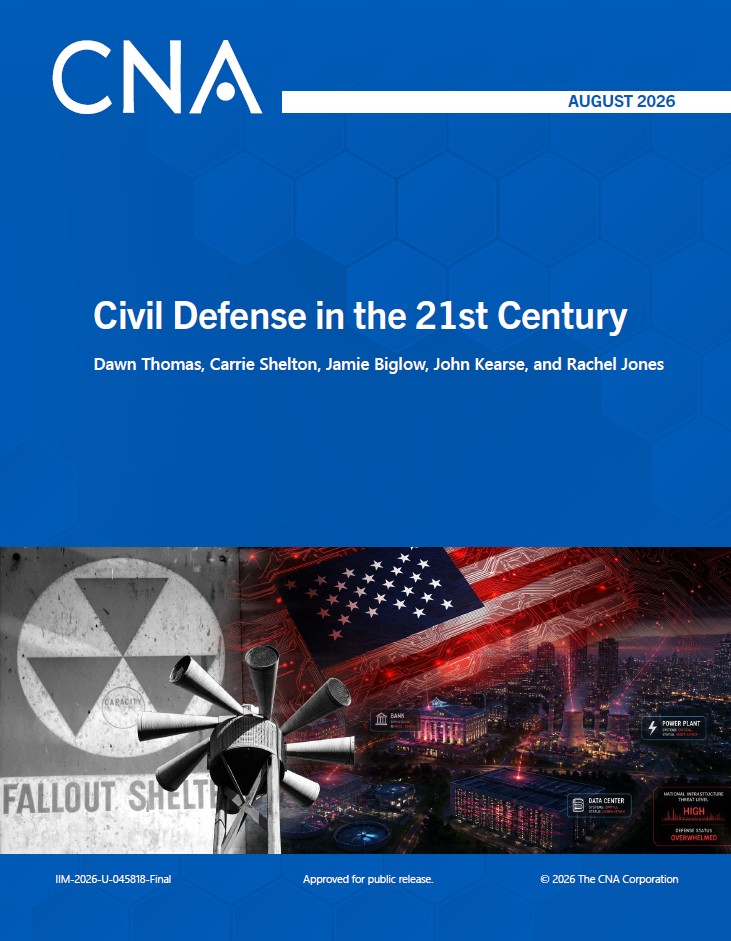
Civil defense is defined as “the system of protective measures and emergency relief activities conducted by civilians in case of hostile attack, sabotage, or natural disaster."
During the height of the Cold War era (spanning the late 1940s to the early 1960s), civil defense was a cornerstone of national security in the United States. This concept extended across all phases of emergency management, including the preparation for, response to, and recovery from an attack on the homeland. Originally, civil defense centered on minimizing the effects of war on the civilian population and dealing with immediate emergency conditions caused by an attack. To this end, civil defense initiatives sought to prepare civilians for large-scale military threats (such as nuclear weapons). Example initiatives include Bert the Turtle’s “Duck and Cover” messages developed by the Federal Civil Defense Administration as well as media campaigns to promote awareness of fallout shelter locations.
As the Cold War ended, the term civil defense fell out of use by federal, state, and local governments, and designated civil defense entities merged into modern-day emergency management agencies. Over the next decades, emergency management efforts evolved to focus on evolving hazards and incidents. For example, terrorism prevention became the focus of emergency management efforts following the September 11 attacks. After Hurricanes Katrina and Rita in 2005, efforts shifted toward regional planning for large natural disasters. During the H1N1 pandemic in 2009, the focus shifted toward public health emergency preparedness.
In 2011, Presidential Policy Directive 8 (PPD-8) (a.k.a. Homeland Security Presidential Directive-8) called for an “all-hazards” approach to national preparedness. PPD-8 directed the creation of the National Preparedness Goal, which defines core capabilities and sets priorities for federal preparedness grant programs, training requirements, and exercise programs nationwide. The National Preparedness Goal was built on an all-hazards framework that encompasses natural hazards, terrorism, pandemics, and cyber and industrial incidents; however, it does not include distinct planning scenarios involving a nation-state military attack or coercion, even though the US is currently facing threats that demonstrate the need for one.
Download reportApproved for public release.
Details
- Pages: 36
- Document Number: IIM-2026-U-045818-Final
- Publication Date: 8/10/2026
Related Analyses