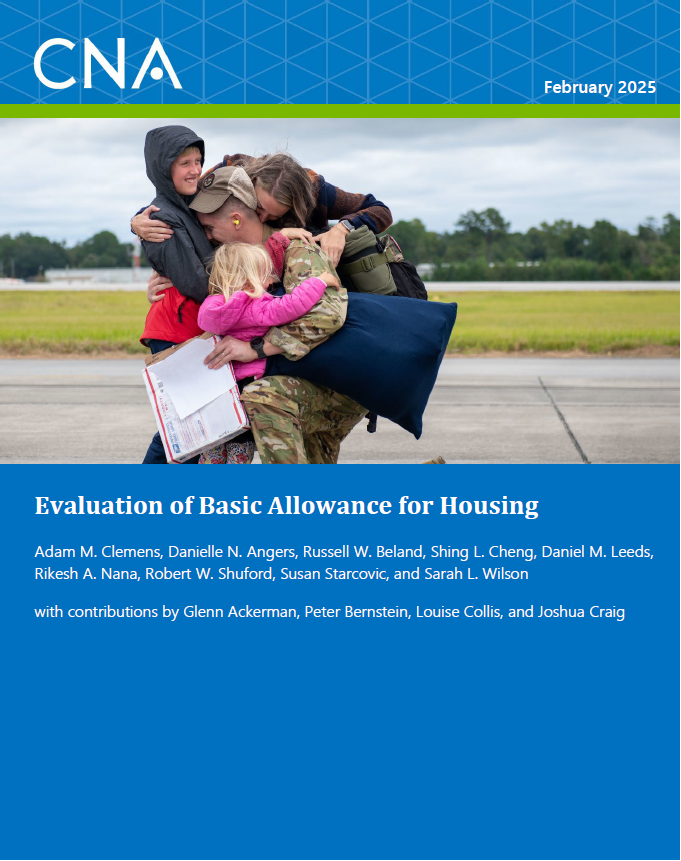
An Evaluation of Basic Allowance for Housing (BAH) Adequacy Standards and Recipient Housing Choices
Results from the 2025 BAH Adequacy Survey
Listen to the 2-Page Summary
Executive Summary
The Basic Allowance for Housing (BAH) is a fundamental component of military pay provided by the US Department of War (DOW) that compensates active duty servicemembers for housing costs in the 50 US states when government quarters are unavailable or when servicemembers prefer and are eligible to reside off base. Despite a steady rise in BAH rates and significant recent research showing that the BAH methodology for rate-setting procedures results in a BAH sufficient to meet set BAH standards, servicemembers continue to report housing costs in excess of BAH. Previous studies have focused on improving BAH methodology to measure the cost for set housing standards accurately. However, very few data have been collected on servicemember housing expenses and the drivers behind servicemember housing choices. The Office of the Under Secretary of War for Personnel & Readiness (OUSW-P&R) contracted with CNA to answer the following fundamental compensation policy questions: Do current BAH adequacy standards (e.g., housing size, type of home) and sampling methodologies result in BAH rates commensurate with actual servicemember choices? If not, why? CNA developed the BAH Adequacy Survey to determine the extent to which BAH helps servicemembers secure their basic housing needs. The survey was designed to collect data from servicemembers and provide a baseline for BAH rate adequacy and to address the fundamental policy questions by answering the following four questions:
- Are servicemembers living in homes above or below BAH adequacy standards, on-base housing standards, and average civilian standards?
- What household and personal factors beyond servicemembers’ military compensation (e.g., total household income, number of school-aged dependents) influence housing budgets and housing choices? Do housing availability and commute times affect housing choices?
- Are servicemembers renting or purchasing homes?
- What are servicemembers paying for housing and utilities? How do their costs compare to their BAH rate?
BAH is designed to cover
Rent
Electricity
Heating fuel
Water and sewer
Survey Results
Are servicemembers living in homes above or below standards?
BAH standards are designed to reflect the choices of comparable civilians in terms of costs and number of bedrooms. Analysis of the survey data reveals that most off-base BAH recipients (84 percent) are not living at standard. We find that BAH recipients are spending more on mortgages and rent than comparable civilians. We further find that BAH recipients choose housing with more bedrooms than comparable civilians and therefore more bedrooms than are allotted to them in BAH standards. BAH recipients also choose housing with more bedrooms than comparable servicemembers living in on-base housing. They are also more likely to live in single family homes than their on-base counterparts and comparable civilians and therefore more likely to live in single-family homes than is indicated by their BAH standard.
What factors beyond military compensation influence housing budgets and housing choices?
Most BAH recipients (87 percent) live off base. Of those, most (63 percent) do not have an option to live on base, but only 21 percent of those individuals indicated that they would live on base if it were an option, implying that BAH recipients prefer aspects of civilian housing or lifestyle. Those who choose to live on base cited amenities and access to medical care as the main reasons for choosing on-base housing, and those who choose to live off base cited privacy and perceived quality of on-base housing as reasons for choosing to live off base. BAH recipients who live off base cited commute (76 percent) and affordable housing (74 percent) as the top reasons for choosing a neighborhood. Cost (83 percent), number of bedrooms (54 percent), and size of residence (46 percent) are the top reasons for choosing a specific home.
Are servicemembers renting or purchasing homes?
BAH is designed to cover rental costs rather than mortgages, but BAH recipients living off base are nearly as likely to purchase a home (48 percent) as to rent one (52 percent). BAH recipients with a spouse or partner are approximately twice as likely to purchase a home as those without a spouse or partner. Other factors that increase the odds of homeownership are being an officer, number of dependent children, serving in the Air Force or Marine Corps, having a dual-income household, and number of completed years of active duty service.
How do servicemembers’ costs compare to their BAH rate?
BAH is designed to cover approximately 95 percent of typical housing expenditures, including rent, electricity, heating fuel, and water and sewer. After including an expected 5 percent cost share, nearly half of servicemembers still overspend their BAH by an additional 5 percent or more. The amount by which they overspend BAH increases with career progression, homeownership, family size, and household income. More than half of servicemembers who overspend their BAH are living in homes above their BAH standard, and nearly half of BAH recipients living off base have increased housing costs because they have purchased homes. Among those who rent homes within their BAH standard, 24 percent overspend BAH by 5 percent or more.
How do costs align with perceptions of BAH adequacy and overall satisfaction?
Overall, 70 percent of respondents are dissatisfied with BAH, and just 10 percent of survey respondents feel that BAH fully covers their basic monthly housing expenses. BAH rate satisfaction and perceptions of BAH adequacy are correlated but often incongruent with servicemember-reported cost data. Among those who report that BAH does not cover their monthly expenses, 46 percent reported monthly costs less than BAH. Among those who believe that BAH covers their expenses, BAH satisfaction is midway between neutral and somewhat satisfied (3.5). Furthermore, those who perceive BAH as inadequate to cover their expenses are more dissatisfied than those who perceive BAH as fully covering their expenses. The incongruencies between perception and actual reported costs indicate that BAH recipients may expect BAH to cover more expenses than policy allows (e.g., home maintenance, pet rent). An alternative explanation could be that servicemembers believe that they are entitled to a higher standard of living than what their BAH rates can afford, despite being based on comparable civilian choices.
Recommendations
We found that servicemember housing choices do not align to average civilian housing standards and that servicemembers across MHAs and BAH profiles frequently spend above or below BAH rates. We provide the following recommendations aimed at improving servicemember housing experiences and future iterations of the BAH Adequacy Survey:
-
We recommend that the Office of the Secretary of War (OSW) develop improved messaging on BAH policy and rates, including standardized educational materials explaining BAH in everyday language as well as the costs and benefits of homeownership. We also recommend that OSW publish BAH rates with separate rent and utilities allowances.
-
If the goal is to align BAH policy with servicemember housing choices rather than with average comparable civilian housing expenditures as is codified in current law, we recommend that Congress weigh whether it is appropriate for BAH rates to exceed average civilian housing costs significantly.
-
Independent of legal considerations, we recommend that OSW close the gap between servicemember housing choices by adopting on-base housing standards for bedroom allocation and reducing residence types to two options (multi- and single-family dwellings) or dispensing with residence types completely. We also recommend that OSW investigate a dynamic model for establishing BAH rates that responds to the unique needs in local markets to align BAH rates better with the costs experienced by servicemembers.
-
We recommend that OSW, Congress, and/or the Services improve the quality of on-base housing by sponsoring a study to assess complaints of privatized and unaccompanied housing quality and allocate funding for improving base housing targeted at the areas identified for quality improvement.
DISTRIBUTION STATEMENT A. Approved for public release: distribution unlimited.
Details
- Pages: 75
- Document Number: DRM-2025-U-043778-1Rev
- Publication Date: 4/30/2026
Related Analyses